
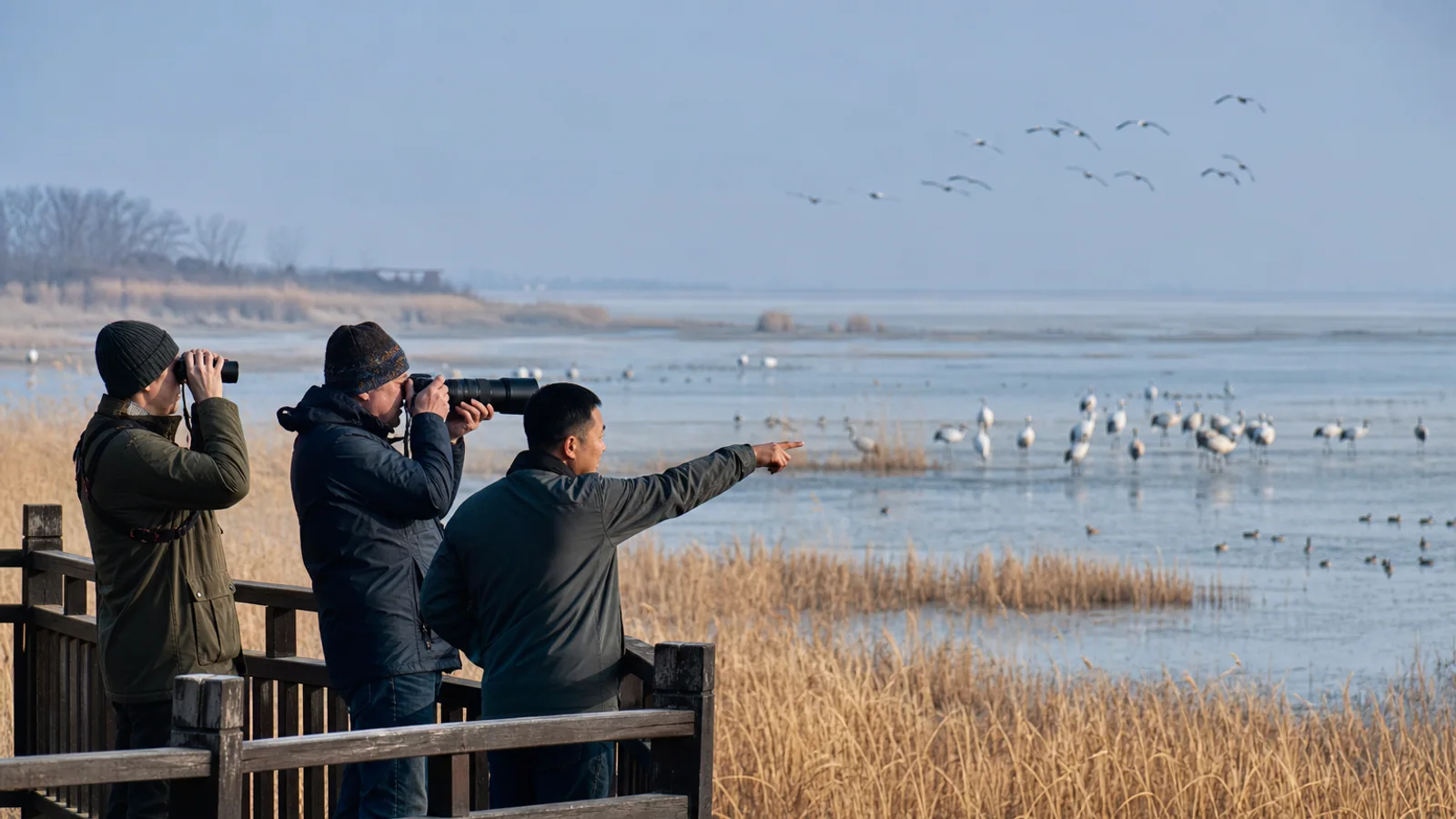
Poyang Lake becomes one of Asia’s great winter bird landscapes as cranes, geese and many other waterbirds gather across changing wetlands. The privilege comes with a rule: the best sighting is the one that does not force a bird to stop feeding, lift off or abandon its space.
Confirm the difficult part first. Tickets, routes and vehicles should remove uncertainty from the journey, not add another layer to manage.
Plan around winter water and bird movement
The broad winter season usually brings the greatest concentration of migratory birds, but exact locations change with water level, food and disturbance. The fourth Poyang Lake International Birdwatching Season ran from November 2025 through January 2026, confirming the core period while events themselves change yearly. Do not build a trip around one old map pin. Speak with a local conservation or birding guide shortly before arrival and let current monitoring choose the viewing area.
Cold fronts, fog and rain affect visibility. Three days offer more than one morning without demanding perfect conditions.
Day one: Nanchang arrival and a quiet introduction
Meet at Nanchang airport or the exact railway station and transfer to the chosen base. A city hotel provides wider comfort, while Wucheng or another wetland base protects early starts. Use the first afternoon for a nature education center, equipment check and route briefing. Bring binoculars for each traveler when possible. A spotting scope adds detail without moving closer. Long lenses are useful, but the trip should remain enjoyable even without professional photography equipment.

Day two: begin before the main visitor flow
Travel early to an official observation area near Wucheng or another location recommended that morning. The national forestry authority describes Wucheng as a major wintering habitat and the site of an international birding season. Stay on legal roads and platforms. Never enter exposed mudflat, reedbed or farmland simply because another photographer is standing there. The local guide reads wind, light and bird behavior, then moves the group only when it can be done without pressure.
Learn the signs that you are too close
A bird repeatedly looking up, walking away, stopping feeding or taking flight is giving the answer. Increase distance. Do not use playback calls, food, drones or sudden group movement. Keep voices low and close vehicle doors gently. Photographing a rare species never justifies disturbance. China’s current local protection actions specifically target harm to wintering birds and their habitat. Follow wardens and temporary closures without debate.
Day three: use a second habitat or slower return
Choose a different official observation point according to current bird distribution, or revisit the stronger area in different light. The wider lake includes multiple established birding destinations around Nanchang, Jiujiang and Shangrao. Do not attempt all of them in three days. Finish with a local meal and return to Nanchang with margin for the train or flight. Mud, fog and rural traffic can slow the road.
Use the vehicle as a quiet observation tool
A comfortable MPV gives space for scopes, tripods, winter layers and a small group. The chauffeur should understand that stopping and turning must remain legal and non disruptive. Avoid a large noisy convoy. For serious photographers, tell us about equipment cases and sunrise starts. For families, the guide can build shorter sessions with warm breaks. We coordinate the hotel, local bird specialist and private vehicle while conservation rules remain the final authority.
Questions travelers ask
When is the best time for birdwatching at Poyang Lake?
Winter is the core season, often from late autumn into early year. Exact bird locations depend on water, weather and food.
Can I see white cranes at Poyang Lake?
Poyang is an important wintering area for white cranes, but no ethical guide can guarantee a specific sighting.
Do I need a local bird guide?
Yes, it is strongly recommended. Current water and bird distribution change, and a local specialist helps the group watch without disturbance.
Current information to check
Review National Forestry and Grassland Administration Poyang birding season. Also review official Wucheng and Shizishan birdwatching profile. Opening hours, tickets, transport controls and operating procedures can change, so confirm them again close to travel.