
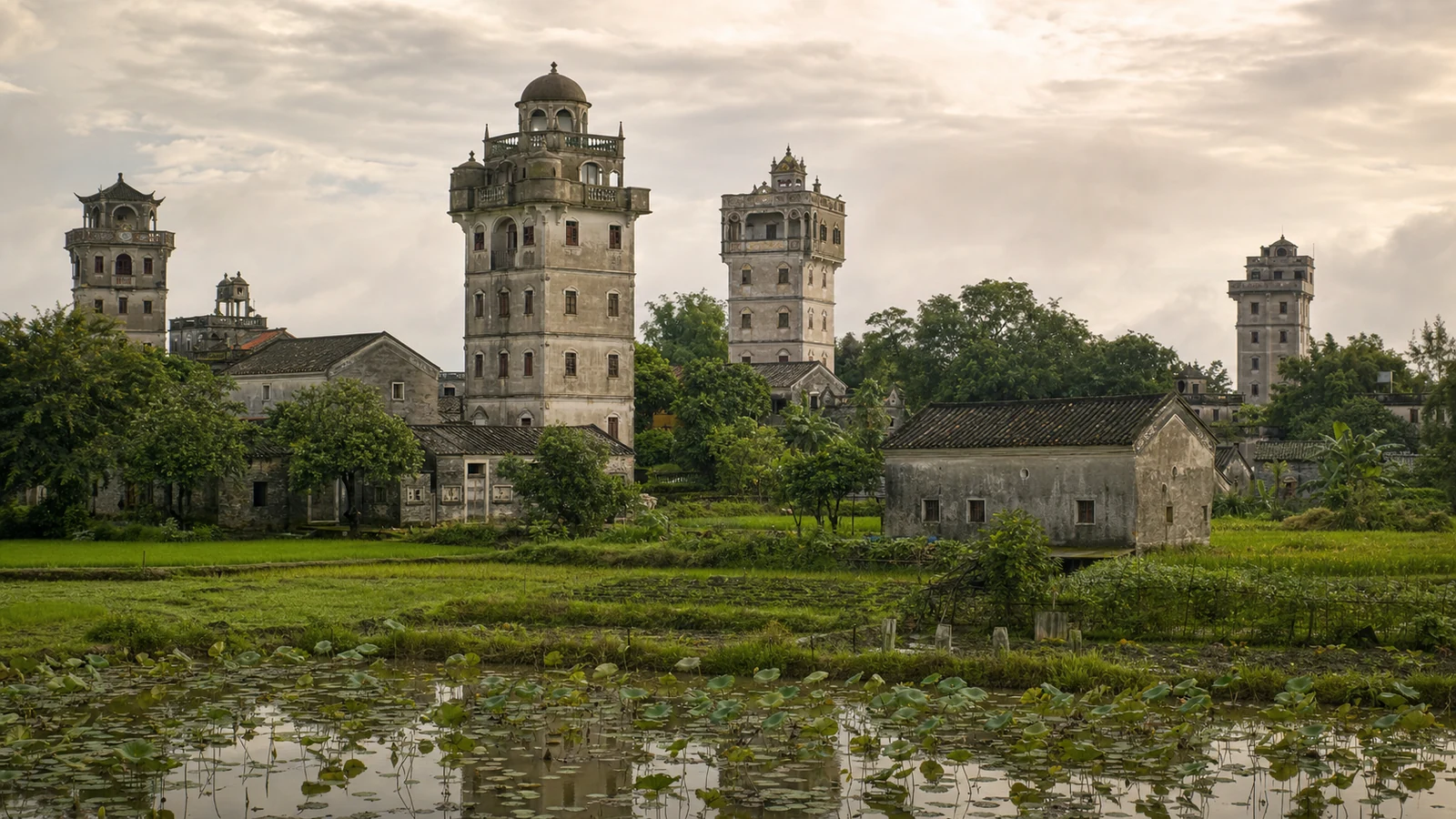
Kaiping often appears online as a quick excursion from Guangzhou. Leave early, photograph one tower, eat lunch and race back. That plan proves you went. It misses the reason the place matters.
The diaolou are fortified homes and watchtowers built across the Kaiping countryside. Their concrete walls, arcades, domes and decorative roofs carry ideas brought home by people who had lived in North America, Southeast Asia and elsewhere. The result is neither a European castle nor a traditional Chinese village copied at a larger scale. It is a local answer to migration, money, family duty and security.
UNESCO inscribed four groups within Kaiping Diaolou and Villages in 2007. They include Zili Village, the Majianglong cluster, Jinjiangli and Yinglong Lou at Sanmenli. Those sites are spread across working countryside. Liyuan Garden and Chikan add context, but they are separate chapters. Two days gives each one room to breathe.
Why two days changes the experience
On a one day return from Guangzhou, road time takes a large part of the day. You can still have a good visit, but you need to choose. Zili Village and Liyuan Garden form the most practical first route. Trying to add Majianglong, Jinjiangli and Chikan usually turns the afternoon into a sequence of parking areas and clocks.
An overnight stay lets you see one major village after the busiest part of the day, eat slowly and reach the bamboo lanes of Majianglong before the heat rises. It also protects the plan when summer rain arrives. A shower can make the grey walls and lotus ponds beautiful, but it can also slow every road.
Chikan is not one of the four UNESCO village groups. It is a restored overseas Chinese trading town with long arcaded streets beside the Tan River. Visit it for a different part of the Kaiping story, not as a substitute for the rural diaolou.
Day one: Guangzhou, Zili Village and Chikan
Leave Guangzhou with time in hand
A private pickup from your hotel keeps luggage with you and removes the need to return to a transport hub. Allow roughly two to three hours depending on the starting district and traffic. Holiday weekends can take longer.
Walk Zili Village
Begin with the paths, ponds and fields before entering a tower. The changing distance is part of the view. From one path the diaolou seem isolated. From another, they sit among family houses and farmland as they were intended to.
Choose Liyuan Garden or a slower village lunch
Liyuan shows the private world of an overseas Chinese family through gardens, villas, bridges and decorative interiors. If architecture fatigue has already started, spend longer over lunch and keep the garden concise.
Continue to Chikan
Check in, rest and walk the arcaded streets after the main day visitors have thinned. Chikan is most useful as an evening and overnight chapter rather than another hurried stop.
How to look at Zili Village
Zili is the easiest place to understand the scale of Kaiping. Traditional homes sit low while the diaolou rise above them. The towers are not identical. Some were communal refuges. Some were private residences. Some watched the surrounding land. Materials include stone, brick, rammed earth and reinforced concrete across the wider property.
Mingshi Lou is among the best known residences in Zili. Its upper levels combine balconies, columns and a roof pavilion, while the lower floors remain defensive and compact. Do not spend the whole visit searching for a single famous facade. The important view is the relationship between tower, house, pond and field.
Field conditions are seasonal. A photograph with bright green rice or blooming lotus is not a promise for every month. Planting, harvest, rain and farm work change the foreground. That is not a flaw. The landscape is still alive.
Day two: Majianglong and the quieter south
Start after breakfast and reach Majianglong early. The village group sits between the Tan River and Baizu Mountain. Bamboo, old trees and lanes create a closer, more shaded experience than Zili. Towers appear gradually through leaves instead of standing across an open field.

This is the place to slow down. Listen for ordinary village sounds. Notice weathered concrete, ventilation openings, old brick and the way paths bend around homes. Keep voices low and cameras away from open doors unless someone clearly permits a photograph. These are heritage villages, but they are not empty film sets.
If your group walks comfortably and current opening conditions allow, continue toward Jinjiangli. Ruishi Lou is the visual anchor there, with a tall, elaborate crown and strong vertical profile. If the morning is already hot or a family member has limited mobility, skip the extra site and enjoy a calm lunch before returning to Guangzhou.
Tickets, walking and comfort
The main tourism area currently brings Zili Village, Liyuan Garden and Majianglong under the Kaiping Diaolou Cultural Tourism Area. Ticket combinations, internal transport and tower access can change. Check the official channel shortly before travel instead of relying on an old screenshot.
Most village walking is not technically difficult, but surfaces can be uneven and wet. Tower interiors involve stairs, and not every upper level is suitable for every visitor. Wear shoes with grip. In summer, carry water, sun protection and a small towel. In wet weather, a compact umbrella is useful on the lanes but awkward inside narrow stairs.
Families should not build the whole day around tower interiors. Children often enjoy the ponds, fields and open paths more. Older travelers may prefer one carefully chosen interior and more time at ground level.
What to eat without turning lunch into a checklist
Kaiping belongs to the wider Wuyi region, where overseas connections and local Cantonese cooking meet. Ask for a meal built around the season rather than a list copied from social media. Local rice dishes, tofu, vegetables, fish and goose may appear depending on the restaurant and your route.
Tell us about allergies and dietary restrictions in writing before departure. A sentence translated into Chinese is more reliable than explaining at the table after dishes arrive. If you have a strict schedule, reserve lunch. A small countryside restaurant may be excellent, but it may not serve a large group quickly without notice.
Where a private car adds real value
The value is not simply having a nicer seat. It is keeping the route connected. The villages are separate, rain can change timing, luggage needs a safe place and the final return to Guangzhou may happen after local day services have slowed.
A good driver can change the order when a car park is busy, wait while the group rests, take you directly to the correct hotel entrance and keep chilled water in the vehicle. For three or four adults with luggage, a comfortable van often works better than a sedan. For a couple traveling light, a standard business sedan is usually enough.
A driver is not automatically a licensed heritage guide. If you want the migration stories, family histories and architectural details explained properly, ask us to add a local guide. The car solves movement. The guide gives the buildings a voice.
If you only have one day
Leave Guangzhou early and choose Zili Village plus Liyuan Garden. Add a relaxed local lunch. Return without forcing Chikan or Majianglong into the final hours. If bamboo villages interest you more than formal gardens, choose Zili and Majianglong instead.
Travelers continuing toward Zhuhai, Macau or another part of Guangdong can use Kaiping as an overnight link rather than returning to Guangzhou. Send the full route before booking. Cross border movements, vehicle permissions and luggage transfers need to be planned as separate services.
Frequently asked questions
Is one day enough?
Yes for two main areas. Two days is much better if you want both the open landscape of Zili and the shaded lanes of Majianglong.
Where should I stay?
Choose central Kaiping for practical hotels or Chikan for an evening in the old trading town. We can match the hotel to the next morning’s route.
Can I enter every diaolou?
No. Access varies by building and current conservation arrangements. Treat the village landscape as the main experience and any interior as an addition.
Is this good for children?
Yes if the pace is gentle. Keep tower stairs limited, add meal breaks and let the fields and ponds be part of the day.
When should photographers go?
Early and late light is softer. Agricultural colors change through the year, so plan for real conditions rather than one famous photograph.
Can you arrange a guide?
Yes. We can combine a suitable vehicle, local cultural guide, hotel pickup and the onward journey in one plan.
Current information to check
Read the UNESCO description of Kaiping Diaolou and Villages, the Kaiping government’s official tourism area introduction and its 2026 destination update. Use China Railway 12306 for current train information. Confirm tickets and opening conditions again before departure.