
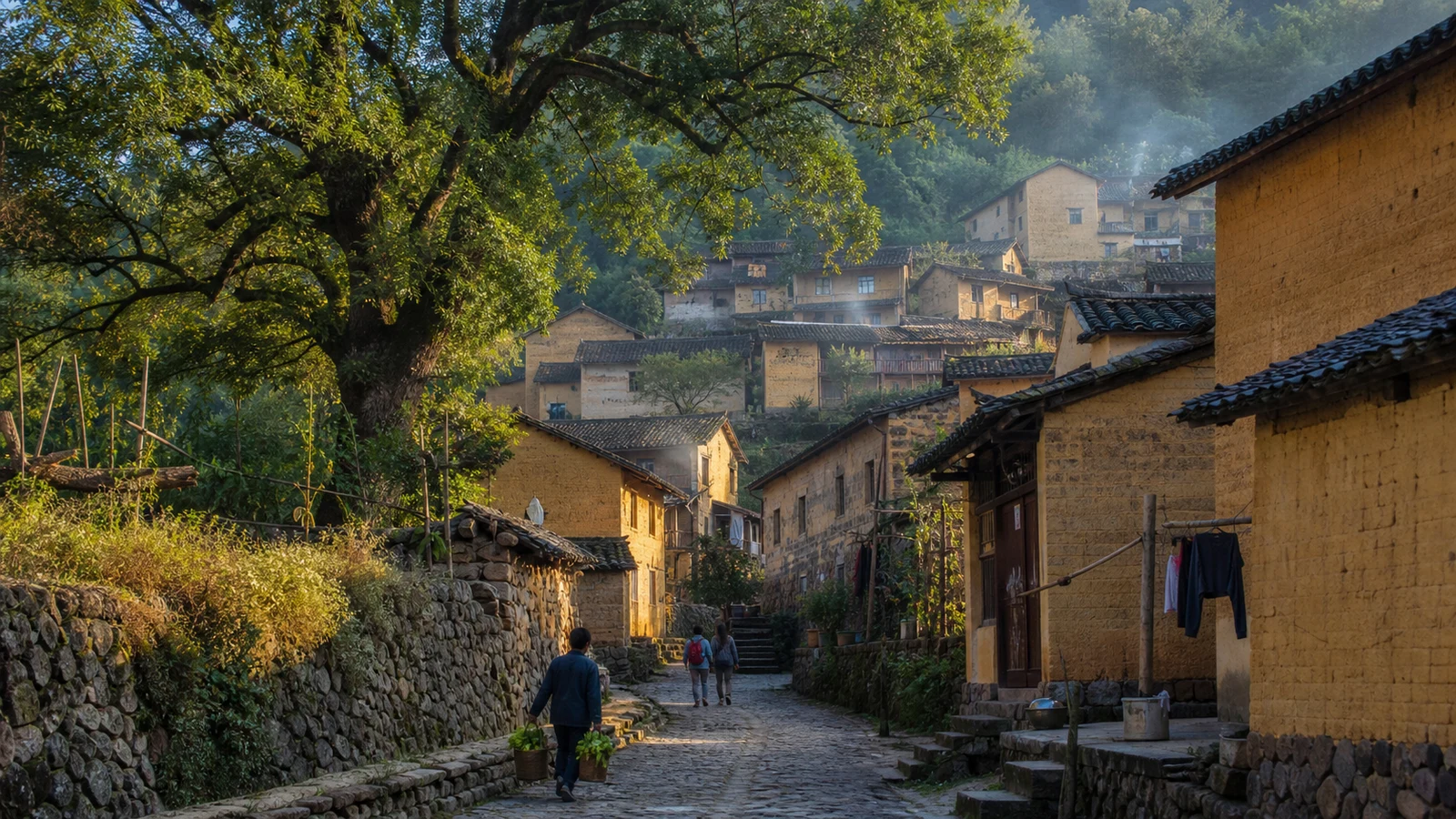
Zhejiang is often reduced to Hangzhou, water towns and polished hotels. Drive south into the mountains of Lishui and another Zhejiang appears. Songyang preserves more than one hundred traditional villages, many still built from yellow earth, timber, stone and dark tile.
Chinese photographers and design travelers have known the county for years. In 2026, Chenjiapu, Yangjiatang and nearby villages became a major domestic story again. Social posts focused on mist, old walls, rural bookshops and the feeling of a slower life. International coverage remains thin, especially when it comes to building a logical road between the villages.
This route is not about finding a place nobody visits. The known villages can be busy on weekends. It is about seeing a living conservation landscape with enough time to notice the differences between places that look similar in a quick carousel.
What the beautiful posts leave out
Early morning mist is not guaranteed. Earth walls look golden only when the angle of sun is right. A quiet lane may fill with day visitors thirty minutes later. Chenjiapu’s bookshop and design projects are part of a modern rural economy, not evidence that the village has been frozen in time.
The roads are also part of the story. Villages occupy separate slopes, and parking can sit below the final lane. Stone paving is uneven. Beautiful old houses may have steep stairs, weak soundproofing and bathrooms that do not suit every guest. Choose an overnight stay for comfort and location, not only for a photograph.
Two slow villages in a day are more valuable than five names. Leave room for tea, weather, lunch and a conversation that was not scheduled.
The three day Songyang route
Arrive and understand the county town
Meet at the most practical regional railway station for your timetable and continue by road. Check in, then walk Songyang’s old street late in the day. Eat locally and sleep early. The old town gives context before the mountain villages.
Yangjiatang and Songzhuang
Reach Yangjiatang before the main day traffic. Walk the layered earth village under old camphor trees, then stop for a simple lunch. Continue to Songzhuang for its stream, old bridge and closer valley atmosphere. Return before mountain roads become tiring at night.
Chenjiapu and one quiet final stop
Visit the cliff village, bookshop and carefully reused old buildings. Choose Pingtian, Xikeng or a tea landscape only if it fits the departure time. Finish at the railway station or continue by private road toward Hangzhou or Shanghai.
Yangjiatang is the visual introduction
Yangjiatang’s houses step down the hillside in layers, producing a broad wall of yellow ochre facades and dark roofs. Large camphor trees frame the best known approach. Arrive when the lane is still quiet, but remember that people live behind the surfaces you came to photograph.
Do not block a doorway, move tools or direct residents into a composition. Ask before making a close portrait. Laundry, vegetables, repair work and parked scooters are not visual mistakes. They are evidence that the village remains part of daily life.
Walk beyond the first viewpoint. The construction becomes easier to read at close range: earth laid in layers, stone bases protecting walls from moisture, timber frames and roofs adapted to heavy rain. A knowledgeable local guide can explain conservation without turning every home into a legend.
Songzhuang changes the scale
Songzhuang feels more enclosed. A stream, an old stone bridge and houses gathered close to water create a scene made famous by photography, yet the pleasure lies in small details rather than one grand view. After rain, stones shine and moss deepens. They also become slippery.
Keep lunch flexible. A small village restaurant may need advance notice for dietary needs or a larger party. Ask for seasonal vegetables, tofu and local dishes rather than expecting a broad international menu. Carry cashless payment options and some backup cash for small vendors.
Chenjiapu is old fabric with a new chapter
Chenjiapu sits more than 800 metres above sea level on a steep slope facing a valley. The settlement has a history of more than six centuries and appears on China’s traditional village lists. It also contains contemporary cultural spaces, design led accommodation and a rural bookshop created inside a reused building.

This new layer has helped create work and fund restoration. It has also made the village famous. During the 2026 Spring Festival period, official reporting recorded intense visitor numbers and full accommodation. Avoid major holidays if you want the calm seen in editorial photographs.
Spend time with both layers. Look at how an old hall becomes a public space, then walk away from the busiest building and watch the village meet the valley. The most successful adaptive reuse does not erase age. It makes age legible.
Do not skip Songyang old street
The county town prevents the journey from becoming a collection of rural backdrops. Its old street contains ordinary shops, snacks, workshops and residents using the space after village day visitors have left. Go near late afternoon when commerce is active but the heat softens.
Try local noodles, tofu and simple dishes according to the season. If you have allergies, carry a written Chinese card. Vegetarian travelers should explain whether stock, lard and meat garnishes are acceptable rather than relying only on the word vegetarian.
When Songyang is at its best
Spring is green and damp, with mist possible. Early summer can be beautiful but wet. Autumn gives comfortable road weather, drying crops and warm wall color. Winter is quieter and exposes the architecture, though unheated old buildings may feel cold.
Rain is not a reason to cancel unless roads or warnings require it. Soft weather suits the villages. Carry a compact umbrella, waterproof shoes and a dry layer in the vehicle. After a storm, let the driver confirm mountain road conditions before departure.
Where to stay
Songyang County town provides easier vehicle access, restaurants and conventional rooms. A village stay gives early and late light, silence and a deeper connection to place. Split the nights if your group accepts changing hotels.
Before choosing a converted old house, ask about the number of stairs, distance from vehicle drop off, heating or cooling, luggage handling and bathroom privacy. “Boutique” does not automatically mean accessible. For an older guest, a comfortable county hotel and early private transfer may create a better journey.
Why the route needs a car
Rail brings Songyang and Lishui within reach of Shanghai, Hangzhou and other eastern cities. The villages remain a road journey. A private car links slopes in the right order, waits through lunch and carries luggage when your final station differs from your first.
A sedan works for a couple. A spacious MPV gives a family room for umbrellas, camera bags and extra layers. Large coaches may face more restrictions on narrow village approaches. A locally experienced driver is more valuable here than an oversized vehicle.
The two day version
Arrive before lunch, see the old street and Yangjiatang, then spend the next morning in Chenjiapu before departing. Leave Songzhuang for another visit. If photography is the priority, sleep in or near one village and protect both golden hours.
Questions travelers ask
Is Songyang really hidden?
Not inside China. The best known villages are major domestic destinations and can become crowded. They remain underexplained in English and are rarely built into a first international itinerary.
Can I visit from Shanghai?
Yes, using rail plus a regional vehicle or a longer private road journey. Three days is the minimum that justifies the transfer.
Do we need a local guide?
You can walk independently, but a guide improves the architectural and social context, helps with village etiquette and arranges local meals.
Is drone photography allowed?
Do not assume it is. Airspace, village rules, privacy and temporary restrictions can apply. Confirm permission locally and never fly close to homes or people without consent.
Current information to check
Read Zhejiang’s official 2026 report on Songyang village tourism and conservation, the Ministry of Culture and Tourism’s Lishui regional route and Zhejiang’s description of Yangjiatang and Chenjiapu architecture. Use China Railway 12306 for current trains and confirm road, accommodation and village access before travel.