
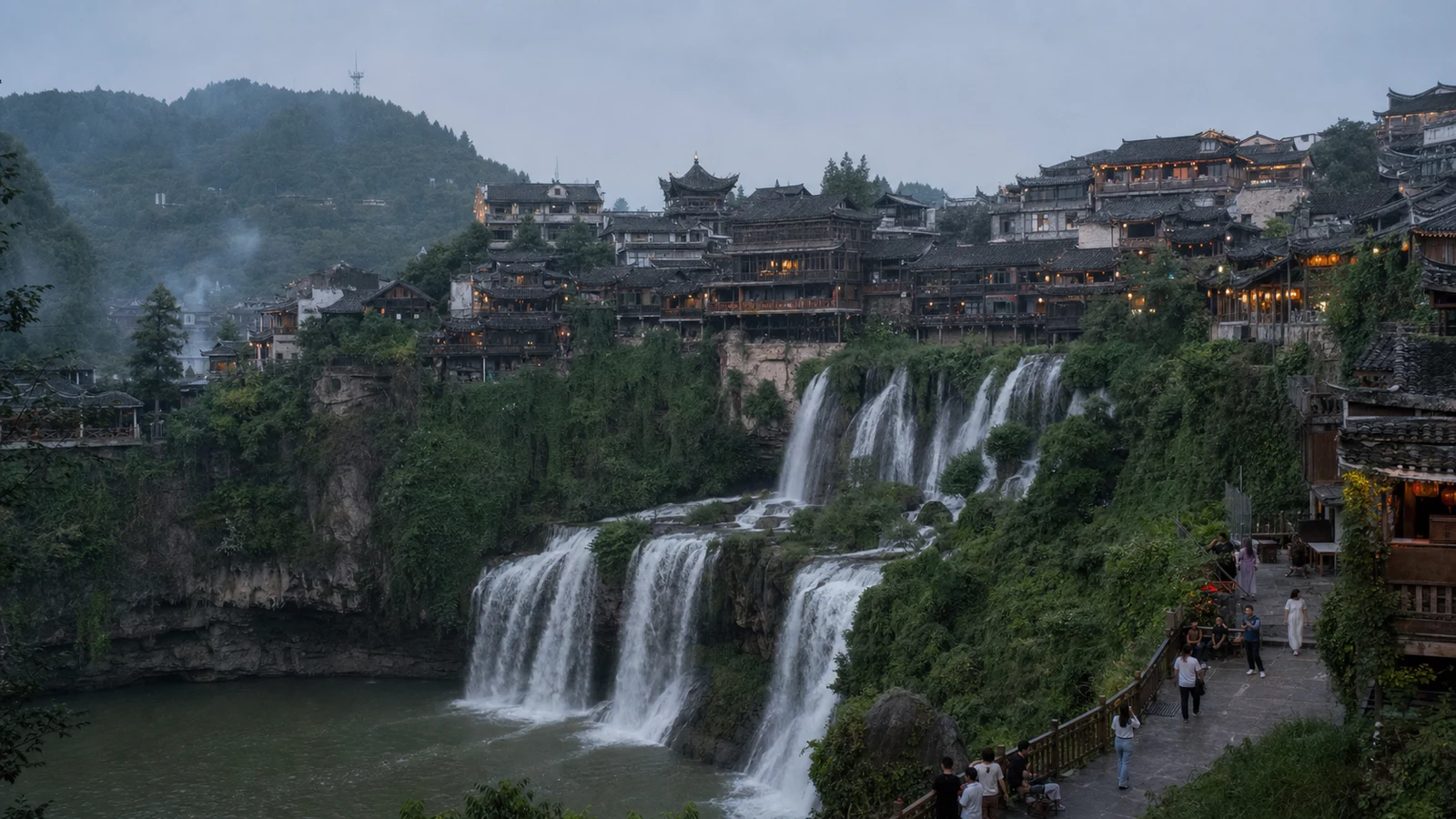
International routes often leave western Hunan after Zhangjiajie, as if the landscape ends at the park gate. Chinese travelers keep going south. Furong Town glows above a waterfall. Ancient red rock folds through humid forest. The road then reaches Dehang Canyon beneath the immense Aizhai Bridge.
This is Xiangxi, the western part of Hunan shaped by Tujia and Miao culture, deep rivers and difficult terrain. UNESCO recognized Xiangxi as a Global Geopark in 2020. Its geological story includes the world’s largest known red stone forest landscape, karst platform canyons and waterfalls.
The places are not one attraction. They form a road journey. A private vehicle matters because the best experience comes from linking railway stations, small scenic entrances, an evening town and a canyon day without returning to the same hub.
What short video leaves out
Furong’s waterfall is broad and dramatic after rain, smaller in a dry period and sometimes photographed from angles that hide modern development. The town has genuine history, but today’s visitor route is commercial and carefully illuminated. That does not cancel its atmosphere. It means dusk and an overnight stay are more rewarding than pretending you found an untouched settlement.
Aizhai Bridge also dominates videos, yet the bridge is only one layer. The older mountain road, Dehang canyon and nearby villages explain why the crossing is extraordinary. Red Stone Forest looks like a visual effect, but it is real geology. Its color changes with moisture and light, so a grey red day after rain can be more truthful than a saturated photograph.
Use Furong for evening atmosphere, Red Stone Forest for geology and Dehang for landscape and human scale.
The three day western Hunan road
Zhangjiajie to Furong Town
Leave after breakfast or meet at a regional station. Reach Furong with time to check in before the busiest evening period. Walk the upper streets in daylight, descend carefully toward the waterfall, eat a simple Tujia meal and revisit one viewpoint as the lights appear.
Red Stone Forest and the road to Jishou
Start early for the red stone formations near Guzhang. Give the geological paths two or three unhurried hours. Continue south through Xiangxi, with a flexible village or river stop if time and current access allow. Sleep in Jishou or closer to Aizhai.
Aizhai Bridge and Dehang Canyon
See the bridge from a legal public viewpoint, then descend into the canyon landscape. Choose a shorter village walk or a longer waterfall route according to weather. Finish at Jishoudong station, continue to Fenghuang or add a fourth night for a slower end.
How to experience Furong Town
Furong was once known as Wangcun and grew around river trade. Its current name is linked to the film Hibiscus Town, which brought national recognition. The settlement sits above the You River, with buildings and paths wrapped around the waterfall and cliff.
Stone can be slick near spray. Wear shoes with grip and do not rush the lower path after dark. Travelers with limited mobility can enjoy upper viewpoints, food streets and selected terraces without completing every staircase. Confirm whether a hotel requires a long walk from the vehicle before booking.
The best hour is not necessarily full darkness. Blue hour preserves detail in the river, vegetation and roofs while the first warm lights appear. Have dinner early, then walk again. Many day groups leave before the town becomes calm.
Red Stone Forest is the surprise
The rock does not resemble the pale limestone most travelers associate with southern China. Iron oxidation gives sections a deep red color. Layers bend, stack and rise in dense forms among vegetation. UNESCO dates the rare sediments to the middle Ordovician, hundreds of millions of years ago.

After rain, red tones deepen and moss becomes vivid, but paths can be wet. On a dry bright day the stone may appear paler. Avoid judging the visit against one heavily edited image. Look at the folds, fossil history and way vegetation occupies cracks.
A local guide adds real value here because the landscape can otherwise become a sequence of shapes. Ask for geological and cultural interpretation, not invented legends for every rock.
Aizhai and Dehang are one landscape
Aizhai Bridge carries an expressway high above Dehang Canyon. Its scale is easiest to understand when you have seen the old road climbing the mountain and the settlement below. Choose official viewpoints. Stopping on a live road for a photograph is unsafe and unnecessary.
Dehang adds streams, waterfalls, fields and Miao community life. The canyon walk should respond to rainfall. Too little water changes the waterfall, while heavy rain can make paths dangerous. A calm village visit, local lunch and shorter path may be the better day for older guests or young children.
Travel respectfully in Tujia and Miao country
Cultural performances can be enjoyable, but they are not the whole identity of Xiangxi. Ask permission before close portraits. Do not enter homes because a door is open. Buy crafts when you genuinely value the maker and can ask who produced the work.
Food is direct and often spicy, with smoked meat, river ingredients, rice tofu and pickled flavors. Tell the restaurant about dietary needs in Chinese before dishes are prepared. Guests who avoid pork or need halal food should plan meals in advance, particularly outside Jishou.
Best season and realistic weather
Spring is green and wet. Summer brings full waterfalls, humidity, heat and storms. Autumn usually offers comfortable walking and clearer road conditions. Winter can be quiet and atmospheric, but cold rain and occasional ice change the experience.
Public holidays transform Furong’s lanes and hotel prices. Travel on ordinary weekdays when possible. In the wet season, keep a dry layer in the vehicle and allow time for slower mountain roads.
Gateways and private transport
Furongzhen station makes the town much easier to reach by rail. Jishoudong serves the southern end, while Zhangjiajie connects with flights and trains. Those stations solve the long distance arrival. They do not fully solve the road between scattered scenic areas.
A private car keeps luggage with the route and prevents a return to Furong after Red Stone Forest. A van suits families or groups carrying hiking gear. The driver should be familiar with legal viewpoints, hotel vehicle access and regional road conditions. A separate licensed guide is useful for geology and community visits.
Should you add Fenghuang?
Fenghuang can follow the third day, but arrive with enough time to sleep rather than beginning another full evening visit. Add a fourth day if you want to walk the old town and river calmly. If the trip already includes several lit ancient towns, choose an extra canyon morning instead. Variety makes a route memorable.
Questions travelers ask
Can this begin in Changsha?
Yes, but rail to Zhangjiajie, Furongzhen or Jishoudong is usually better than making the whole distance by road. We can meet the train and begin the regional drive.
Is Furong Town too commercial?
It is commercial, and it can still be beautiful. Stay overnight, avoid a public holiday and spend time near the river rather than only in the busiest shopping lane.
Do we need hiking shoes?
Full boots are not essential for standard scenic paths, but closed shoes with strong grip are. Spray and rain make stone slippery.
Can we do the route in two days?
Choose Furong and Red Stone Forest, or Furong and Aizhai. Trying all three in two days removes the quiet road stops that make the journey special.
Current information to check
Use UNESCO’s official Xiangxi Global Geopark guide, the Hunan culture and tourism department’s western Hunan rail route overview and China’s Ministry of Culture and Tourism description of the Furong and Red Stone Forest route. Confirm scenic access, train schedules and weather notices again before departure.