
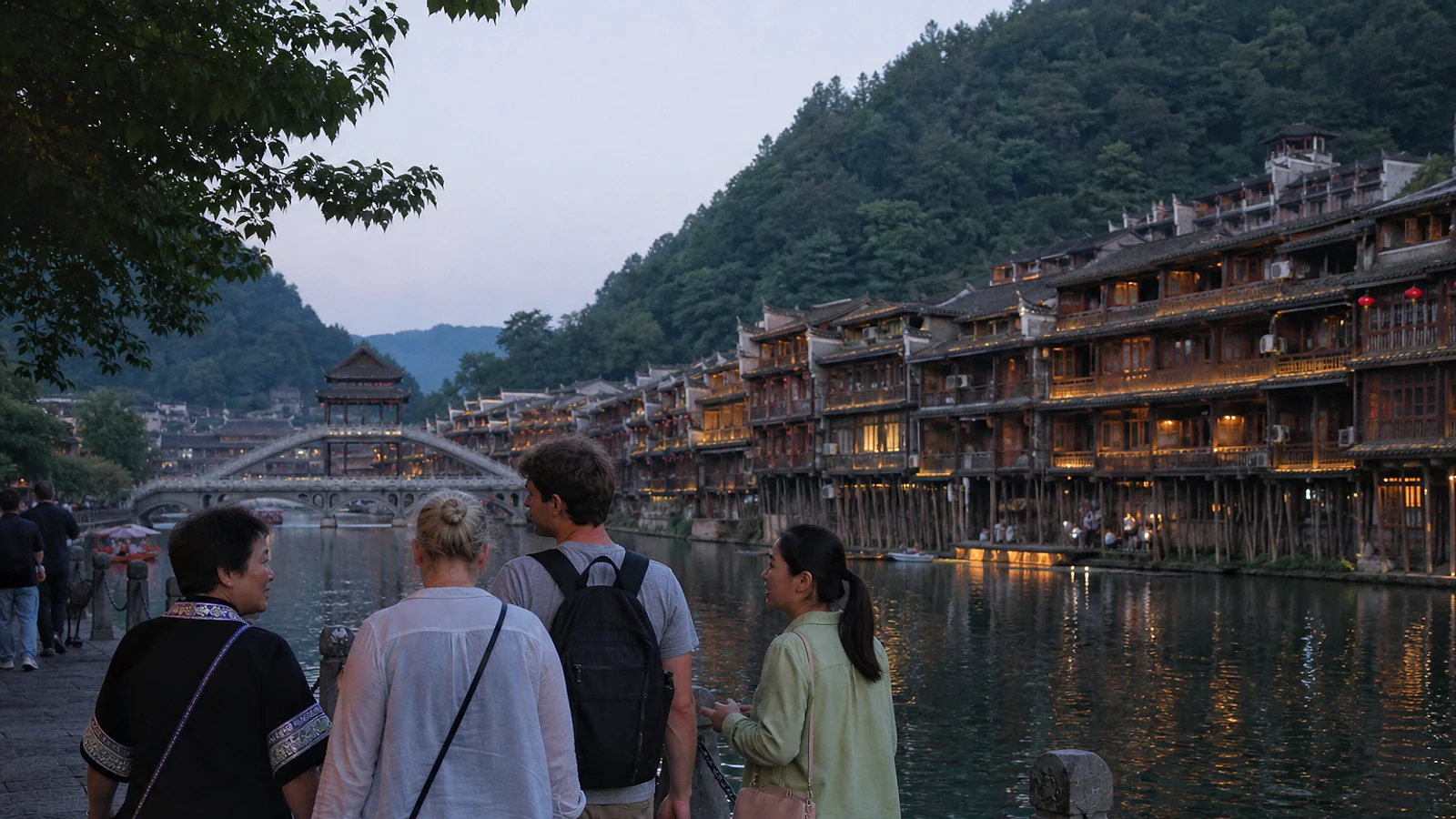
Zhangjiajie and Fenghuang are often sold as a single Hunan idea, but they are completely different journeys. Zhangjiajie is a landscape of sandstone pillars, cliff paths and scenic transport. Fenghuang is a river town of timber stilt houses, stone lanes, old gates and living Tujia and Miao culture.
The connection is easier than it once was. High speed rail serves Fenghuanggucheng Station, and the sightseeing maglev links the station area toward the town. A private car remains valuable for direct hotel pickup, luggage and a wider western Hunan route.
Why Fenghuang belongs after Zhangjiajie
After several days looking outward at monumental scenery, Fenghuang changes the scale. The Tuojiang River holds the town together. Houses stand on timber supports, bridges cross at different heights and daily life continues behind the most photographed facades.
It is not hidden. Fenghuang is one of China’s best known ancient towns and its nightscape attracts large domestic crowds. The reason to go is not solitude. It is the combination of river architecture, western Hunan culture and a journey that continues beyond the usual peak forest checklist.
Arrive before blue hour and leave after one quiet morning. Seeing only the fully lit night turns Fenghuang into a stage set. Morning gives the town back its depth.
Train or private car from Zhangjiajie?
Choose high speed rail for the fastest simple connection
Rail can connect Zhangjiajie West and Fenghuanggucheng in around an hour on suitable services, although the timetable changes. Add hotel to station time at both ends, security, boarding margin and the final maglev or vehicle transfer. The station is not the old town riverfront.
Choose a private car for door to door continuity
A road transfer begins at a Wulingyuan or Zhangjiajie hotel and finishes at the closest legal vehicle access to the Fenghuang hotel. It takes longer than the train itself, but removes station handling and keeps luggage with one team.

Road travel is strongest when adding Furong Town, Aizhai Bridge or a village visit on a longer route. Do not add all of them on the same day as a proper Fenghuang arrival.
The two day Fenghuang route
Finish Zhangjiajie without a rushed exit
Check out after breakfast. If a final Tianmen Mountain or national park visit is planned, leave luggage with the chauffeur or hotel and protect enough time for the connection. Do not book the tightest train after a cableway day.
Arrive and understand the river
Check in, then walk the Tuojiang before full darkness. Identify Rainbow Bridge, the stepping stones and the line of diaojiaolou houses. A local guide can explain town history before the lights dominate the view.
Enjoy the lights without staying in the loudest lane
Take a boat trip only if the current route and queue make sense. Eat away from the most crowded bridge, then return to the river after dinner. Respect hotel guests and residents in narrow lanes.
Walk early, then add cultural context
Start before breakfast on the quiet riverfront. Visit selected old town sites after opening, learn about Shen Congwen and local Miao and Tujia traditions, then depart after lunch or stay a second night.
What to see without turning it into a checklist
The Tuojiang River is the main route. Walk one bank in late afternoon and the other in early morning. Rainbow Bridge creates the classic central view, while smaller crossings and stepping stones change the relationship with the water.
Select only a few interiors. Shen Congwen’s former residence provides literary context. Old gates, halls and small museums explain the town beyond its illuminated facades. A boat journey gives a lower view of the stilt houses, but walking remains essential.
Move away from the most photographed loop. Markets, breakfast shops and ordinary lanes show how a famous visitor town still functions. Ask before photographing someone at close range, especially in cultural dress or at work.
Travel with cultural context
Fenghuang is in Xiangxi Tujia and Miao Autonomous Prefecture. Music, embroidery, silverwork, food and festivals are not decorative content created for visitors. Choose guides and performances that name the community, explain what is adapted for the stage and avoid treating people as costumes.
A locally informed guide helps distinguish history from a sales script. The strongest experience may be a conversation about a textile technique or family food rather than the largest evening show.
Food is part of the region’s identity. Ask about sour flavours, smoked ingredients, river fish and chilli levels. Travelers with allergies or halal requirements should carry a written Chinese explanation and confirm cooking oil, stock and cross contact.
Where to stay in Fenghuang
A river view room sounds ideal, but can involve stairs, nightlife noise and a long luggage carry from vehicle access. A quieter hotel one or two lanes back may offer better sleep while remaining close to the water.
Ask for the exact drop point, number of stairs, elevator availability, soundproofing and breakfast. If traveling with older guests, a modern room with direct road access is often more luxurious than a delicate balcony above the busiest bar street.
Your chauffeur may not be allowed at the hotel door. Arrange a porter or hotel meeting at the legal vehicle point. This detail matters most in rain and after a long Zhangjiajie stay.
Furong Town, Aizhai and the deeper Xiangxi route
Furong Town is north of Fenghuang and famous for houses beside a waterfall. It works best through late afternoon and dusk, which means adding time rather than using it as a one hour roadside photograph. Our western Hunan road guide explains a longer route through Furong, Red Stone Forest and Aizhai.
Aizhai Bridge and Dehang area add canyon landscape and Miao culture west of Fenghuang. Use another day. The current Hunan tourism strategy treats the wider Zhangjiajie region as a connected journey, but connected does not mean rushed.
Questions travelers ask
Should I visit Fenghuang if I already saw a Jiangnan water town?
Yes. Fenghuang’s timber river architecture, mountain setting and Xiangxi culture are different from the white walled canal towns near Shanghai.
Is one evening enough?
No. An evening shows the famous lights but misses the quiet river, morning commerce and cultural sites. Stay at least one night and protect the next morning.
Can I continue from Fenghuang to Guilin or Guizhou?
Yes, using rail and road connections through western Hunan and neighbouring provinces. The best route depends on the current timetable and whether Fanjing Mountain, Tongren or Guilin is the next priority.
Current information to check
Review Hunan’s official information on Fenghuang Ancient Town, the Fenghuang sightseeing maglev and the province’s current Greater Zhangjiajie inbound routes. Use China Railway 12306 for the current train schedule.